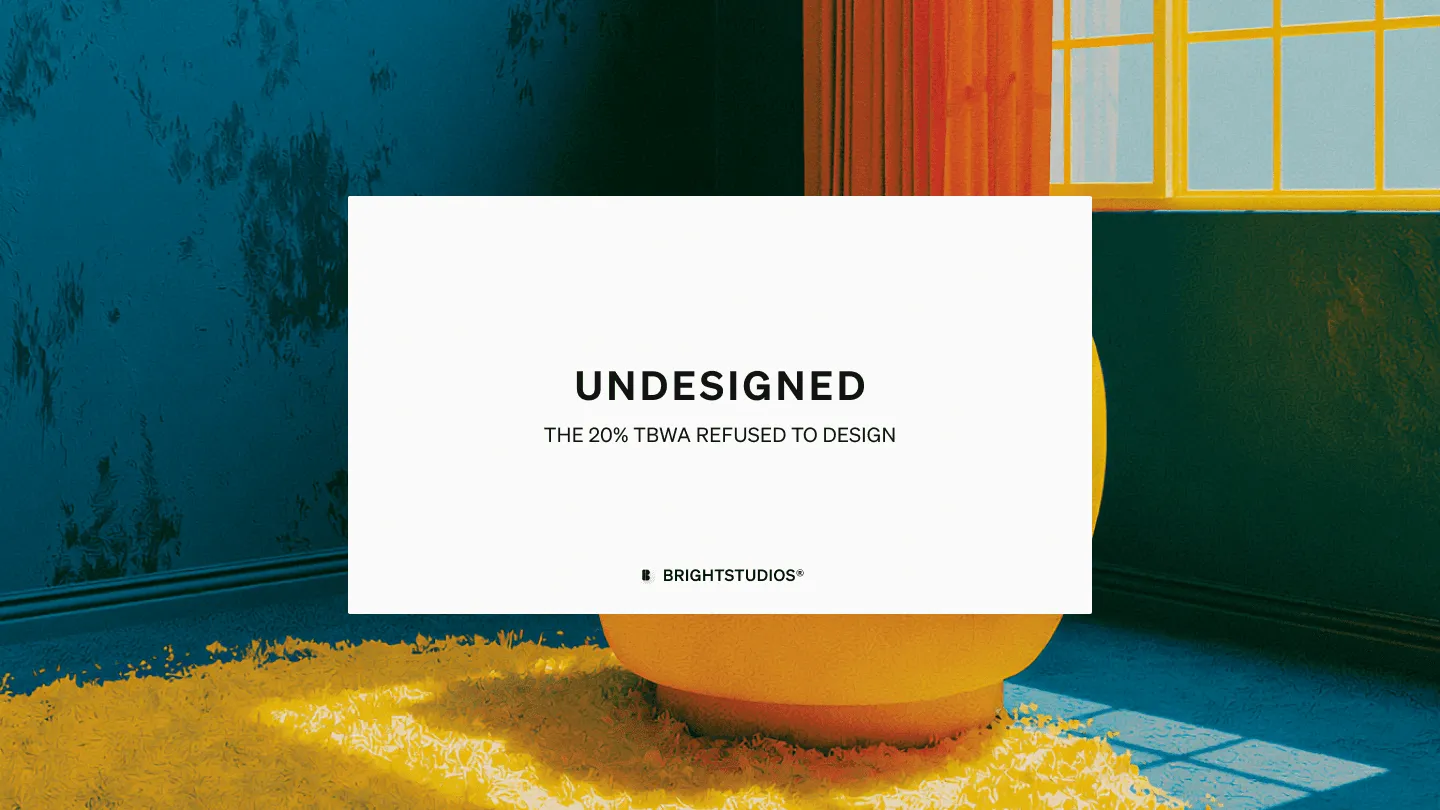
Near the end of TBWA's launch film this week, the agency's leaders take turns drawing the backslash by hand. Every one comes out wobbly, personal, slightly wrong, and the film presents this as the point. In the new system, a leader's crooked backslash counts as correct usage. Any other guidelines document on earth would file that footage under logo misuse. TBWA is calling it the brand.
The relaunch shipped Tuesday, done in-house by DXD, the global design unit Bruno Regalo runs, and Brand New picked it up Thursday. The equity stays put: backslash, yellow, black. Around it arrives the full analog wardrobe. Serifs return, there's a parchment tone named Analog after old envelopes and film stock, ink splatters, hand-drawn pirate doodles nodding to the Jobs line Lee Clow loved about pirates and the navy, photography that looks caught rather than staged.
About that wardrobe, design director hat on: it's the reigning convention wearing a new lanyard. Granola wrapped a $1.5 billion company in its founder's handwriting, half the AI category is reaching for grain and wobble, and now the company that trademarked Disruption has arrived at the exact aesthetic the rest of the market already agreed on. The execution is lovely and I'd pass most of it in crit, but analog warmth as an answer to AI stopped being a position and became a uniform sometime last year. If the texture were the whole project, this issue would be a paragraph.
The architecture underneath is the project. Roughly 20 percent of this identity was left undesigned on purpose. There is no rigid template, there's a palette. Every office gets its own postmark, its own motifs, its own hand on the backslash. Regalo says it straight out in the LBB interview: a flexible guideline rather than a perfect one, deliberately. The bet underneath is one I'd defend in any boardroom: an identity has two jobs, recognition and belonging, and they're solved by opposite mechanisms. Recognition needs a few assets locked without exception. Belonging needs freedom granted on purpose. Guidelines fail when they try to do both jobs with rules.
The problem the open fifth is solving
Look at what this system has to hold together. Since the Omnicom and IPG consolidation, TBWA has been absorbing people and whole creative cultures from LOLA, MullenLowe and DDB, shops with their own mythologies and strong opinions about design. Erin Riley describes the result as a collective rather than a network, which is a polite way of saying the first audience for this rebrand sits inside the building. Regalo more or less admits it when he frames the job as making a few thousand newly arrived creatives want to wear the T-shirt.
Rules cannot produce that feeling. A team that just watched its own brand get retired will not fall in love with a PDF about clearspace. Handing that team a postmark and the right to draw its own backslash sends a different message, and the message is ownership. The open fifth does the belonging work while the locked mark and the yellow do the recognition work, and the split is drawn with real precision: nothing that carries recognition at a glance got opened, nothing that carries local pride got locked.
I write these documents for a living, so let me tell you the quiet part. The pages clients scrutinize hardest are always the prohibitions, the crossed-out logo sins. The page that decides whether the system survives contact with a real team almost never gets written: where, exactly, people are free. Leave it out and the team writes it themselves, one undocumented exception at a time.
The opposite bet, three weeks apart
Two issues ago this newsletter was about Coca-Cola encoding its identity into machine-readable rules, guidelines that live inside the asset and apply themselves. Now the industry's loudest disruptor ships a system built on sanctioned deviation. Same summer, opposite answers, and the useful question is what variable each company was setting. Coke's system exists for an army of anonymous production designers across two hundred markets who need to get it right without thinking. TBWA's exists for a few thousand proud creatives who need to feel like owners. Encoded freedom is a dial, and you set it by asking who has to live inside the system and whether you need their compliance or their investment. Both companies read their own room correctly.
The skeptic in me wants to see month nine. Twenty percent open is the kind of number that presents beautifully on a launch slide, and the test arrives when some office's postmark has quietly evolved into a second logo and a human at DXD has to rule on whether that was the system working or the system failing. Flexible identities rarely die of one bad decision; they die of a thousand reasonable exceptions. The enforcement document is where this idea survives or doesn't, and nobody publishes that one.
The so-what for founders
You will hit TBWA's problem without ever acquiring anyone. Somewhere around Series B the team doubles, the deck forks into five private versions, and every AE starts shipping their own screenshots. The standard response is to tighten: more rules, a longer PDF, a Slack channel where your designer polices fonts. Six months later the guidelines are stricter and less followed at the same time, because a rule nobody enforces teaches the team that every rule is optional, and the locks that matter lose their authority along with the trivia.
So run TBWA's split on your own system. Sort every rule in your guidelines into two piles: the ones you would stop a launch to enforce, and everything else. The first pile should hold about five things, the assets that make you recognizable at a glance, and those get locked absolutely, no Friday waivers. Everything in the second pile gets converted from a soft rule into designated freedom: name the zones where sales, product marketing and the regional team can move without asking, and write those freedoms down with the same precision you'd give a logo lockup. Granted freedom is what makes the remaining locks credible.
The companies that read as one company were never the ones with the thickest guidelines. They're the ones where everyone knows exactly which five things never move, and everyone knows it partly because five is a small enough number to actually defend.
Reply with the five rules you'd stop a launch to enforce. If the answer doesn't fit in one message, that's the finding.
