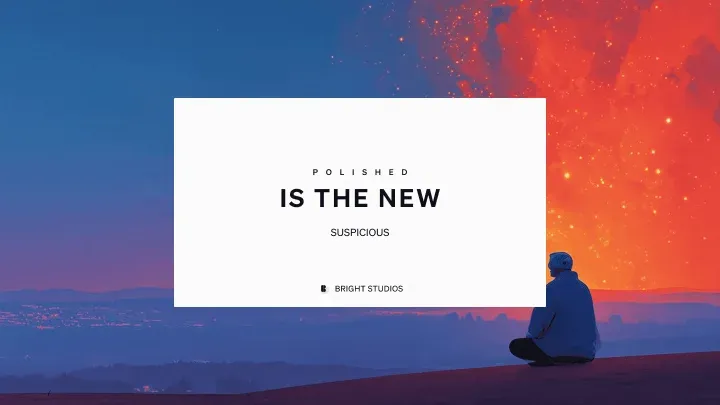
I’ve been staring at SaaS landing pages all week and I can’t tell them apart anymore.
Clean sans-serif. Gradient mesh background. Sharp headline about “empowering teams” or whatever. Two years ago, that combo made your company look legit. Now it makes people wonder if a human touched it at all.
Instagram’s Adam Mosseri basically said the quiet part out loud this year: the platform is “moving away from a world where polished, professional-looking content signals quality towards one where it signals the opposite.” Canva declared 2026 the year of “Imperfect by Design.” And get this: consumer preference for AI-generated content dropped from 60% in 2023 to 26% today. People aren’t just noticing the sameness. They’re actively rejecting it.
The brands winning right now aren’t the ones that look the most polished. They’re the ones that look the most intentional.
“Good enough” got way too easy
Any founder with a Midjourney subscription and 20 minutes can now produce a hero image that would’ve cost $3,000 in 2023. Any marketing hire can spin up a landing page, a social post, a pitch deck that looks… fine. Professional. Competent.
And competent is the kiss of death now. Because when everyone can look competent, it stops being a signal. It’s just noise.
The B2B SaaS landscape is drowning in what one agency called a “sea of sameness.” The median Series A round has climbed to $18M, investor expectations are through the roof, and yet these companies are showing up with brand assets that could literally belong to any of the 14,000+ funded SaaS startups in the market. Swap the logos and nobody blinks.
Looking polished used to mean “this company is real.” Now it means “this company used the same tools as everyone else.”
The best brand work I saw this month? Motorcycle racing
Not SaaS. Not fintech. Motorcycle racing.
Pentagram’s rebrand of MotoGP just won the Grand Prix at Transform Awards Europe, and honestly, more B2B founders should be studying it. They didn’t just make MotoGP look cooler. They built a system. Five sub-brands (MotoGP, Moto2, Moto3, MotoE, eSport) collapsed into one flexible identity. A custom variable typeface with alternate characters that come alive in motion. And they deliberately kept the masterbrand neutral so it plays nice alongside any team’s colors without clashing.
The nerdy part I love: every single decision has a reason you can point to. The ‘M’ references two bikes at lean angle. The ‘O’s echo wheel geometry. The neutral palette isn’t boring. It’s a strategic bet on longevity and flexibility.
That’s the gap between a brand that was designed and a brand that was decorated. One has an argument. The other just has an aesthetic.
Most B2B tech companies I work with are still decorating. They pick colors they vibe with, choose a typeface that feels modern, generate some abstract 3D blobs, and ship it. Looks great on launch day. Falls apart the minute they need a conference booth, a partner co-branded page, or a product UI that actually holds together.
Show your work; that’s the flex now
This is the counterintuitive part: when AI can fake polish, the most credible thing a brand can do is let the thinking show through. Not in some navel-gazing “our brand journey” blog post. In the actual work.
Your color system has a logic someone could reverse-engineer. Your messaging hierarchy means slide 2 of your pitch deck couldn’t belong to any other company in your category. Your website doesn’t just look good. It makes a case for why you exist.
There’s actually a whole movement around this. The Content Authenticity Coalition is pushing C2PA standards, basically “nutrition labels” for digital content that prove a human made it. That’s useful for photographs. But for brands? The nutrition label is the system. It’s the proof that someone sat down, made tradeoffs, and built something that only works for this company.
The companies raising the best rounds right now, the ones getting acquired at multiples that make their competitors sick, they don’t just have a nice logo. They have a brand that works like infrastructure. Consistent, extensible, impossible to mistake for anyone else.
OK so what do you actually do about this?
Pull up your pitch deck. Go to slide 2. Now mentally swap your logo for a competitor’s. Would anyone notice?
If the answer is no, that’s not a brand problem. It’s a differentiation problem. Your surfaces are just making it visible.
Stop optimizing for polish. Start optimizing for specificity. Every design choice defensible. Every line of copy making a claim only your company can make. Every visual part of a system, not a one-off vibe check.
Because in 2026, the most dangerous thing your brand can be isn’t ugly. It’s forgettable.
If your surfaces aren’t keeping up with the company you’ve actually become, that’s the exact gap we close at Bright Studios. Let’s talk and figure out where you stand.
