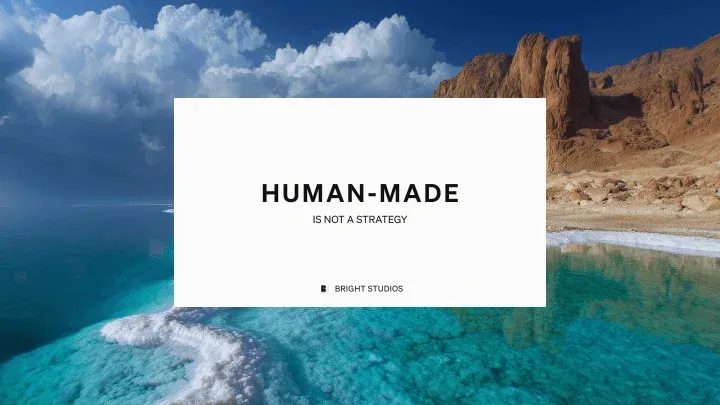
So Canva dropped their 2026 trends report and shocker "Imperfect by Design" is the move. Lo-fi searches up 527%. DIY scrapbook elements up 90%. Every agency on my timeline is suddenly selling "100% human" creative like it's organic produce at Whole Foods.
I get it. AI slop is real and oeople are tired of looking at the same Midjourney-glazed everything. That part's true.
The anti-AI backlash is producing the exact same undifferentiated sameness it claims to be fighting.
Think about it. Every brand that spent 2024 racing to automate is now racing to prove they didn't. "Human-made" became the new premium badge overnight as some reports have anti AI design commanding 10–50x the cost of AI alternatives. Cool. Except now everyone's doing it.
When every SaaS startup's landing page has hand-drawn illustrations, intentionally rough textures, and a serif font that whispers "we're the thoughtful ones" you haven't fixed anything. You swapped one uniform for another. The grid changed. The differentiation problem didn't.
Go look at B2B SaaS landing pages right now. Calm design, clean layouts, bento grids, story-driven messaging. Fine instincts individually. But Notion does it, Linear does it, Framer does it, and then 200 Series A companies copy all three of them. At that point? How it looks is irrelevant. What matters is what it says.
Here's a good contrast. Wonderful AI startup just raised $150M in a Series B this month. $2 billion valuation. They're thirteen months old. Four months between their A and B. Scaling from 350 to 900 people across 30+ countries.
Their brand doesn't lead with "imperfect by design" or "made by humans." It leads with a razor-sharp position that AI customer service agents for non-English-speaking markets, fine-tuned for local language, cultural norms, and regulatory environments. That's it. "We're this, not everything."
That specificity is what makes them credible at $2B. Not the typeface. Not whether someone hand-drew the illustrations.
The companies raising the best rounds right now? They don't have better aesthetics. They have tighter positioning. They made a bet specific enough to be wrong — and that's exactly what makes it stick.
Now here's the part nobody is really talking about and I'm tired of it.
Your customers do not care how your brand was made. Your investors don't care. Your future hires scrolling your careers page definitely don't care.
They care if it makes them feel something specific. If it signals competence, authority, momentum. If it answers the question every B2B buyer is quietly asking: "Are these people serious?"
A hand lettered logo with no strategy behind it says "we care about craft." A systematic identity built on real positioning says "we know exactly what we're building and who it's for." One's a vibe. The other's a growth asset. Those are not the same thing.
The data backs this up. Clutch's 2026 design industry report found that higher-level strategy work (brand positioning, core identity development) stays human-led, while tactical output gets increasingly automated. That's not human vs. machine. That's a division of labor. The companies getting it right aren't picking a side in the tool war. They're investing in the layer that actually creates separation: the thinking underneath the pixels.
Now if you don't trust me, go open your website right now. Cover the logo. Could this be any company in your category?
If yes then your problem isn't whether you used AI or not. Your problem is you don't have a point of view specific enough to survive a screenshot test. No amount of hand-drawn texture fixes that.
The "human-made" aesthetic will fade like every trend does. Give it 18 months. What won't fade is a brand rooted in a real position as systems beat styles and positioning beats polish every time.
Stop debating the tools. Start defending the decisions.
Brand could belong to anyone in your category? Let's fix that. Book a call — we start with positioning, not pixels.
Sources & links
Wonderful raises $150M Series B at $2B valuation — TechCrunch
9 Trends That Will Shape B2B Brands in 2026 — B2B International
