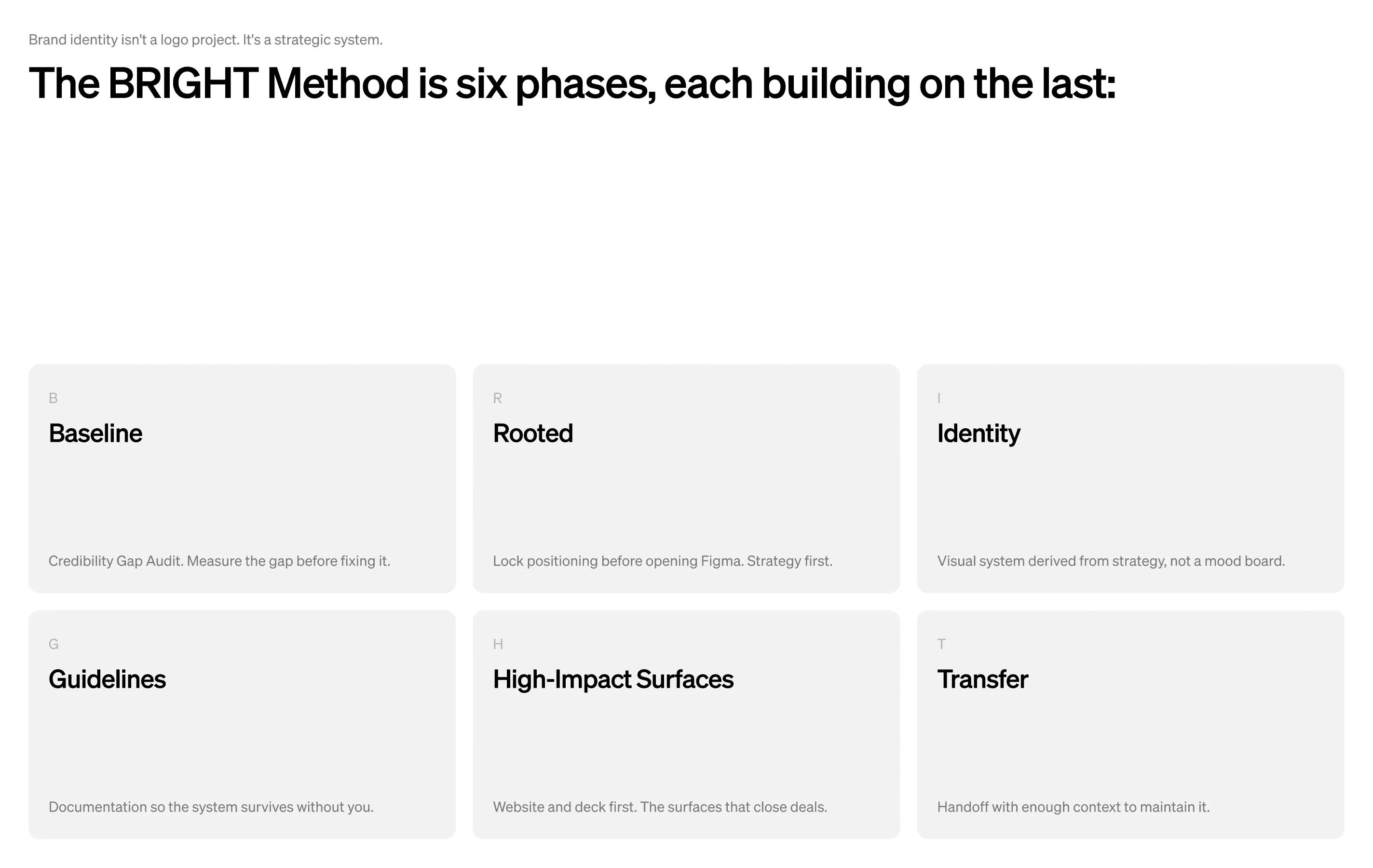
The BRIGHT Method
How we close the gap between what you are and what you look like.
Six stages. One through-line. Every decision traceable back to strategy.
B
Baseline Audit the credibility gap. Score the current state against competitors.
R
Resolve Lock positioning, messaging, and narrative before any design begins.
I
Identity Visual and verbal identity built from the strategy.
G
Documentation so the system survives without you.
H
Website and deck first. The surfaces that close deals.
T
Handoff with enough context to maintain it.
Most rebrands for growth-stage tech fail for the same three reasons. The positioning gets decided by whoever pushes hardest in a workshop, not by the market. Design starts before strategy is locked, so the visual system carries assumptions no one has tested. And the whole project ships as a PDF guidelines document instead of the surfaces that actually move deals.
The brand that results looks fine. It just doesn’t close.
The BRIGHT Method exists to fix those three failures, in that order.
Stage 1
Baseline
Credibility Gap Audit
We score your current brand against your growth stage, your competitors, and the buying moment you’re in.
Competitive positioning map
Where you sit relative to 8–12 direct competitors on the dimensions that matter.
Traffic and behavior read
What prospects do on your current site, where they fall off, what they search for when they land.
Conversation artifact review
Your sales deck, RFP responses, customer interview notes. We read what your company actually says when a dollar is on the line.
Most rebrands start with a creative brief someone wrote in one sitting. By the time the work ships, the brief reads like wishful thinking. Baseline replaces the brief with data. Nothing downstream is defensible without it.
Diverge (formerly Dialoge). Before the rebrand, Baseline scored four measurable gaps in one session — language, platform, name, positioning. Every downstream decision traced back to one of those four.
What you walk away with:
A Credibility Gap Score, a competitive positioning map, a prioritized gap list, and a decision record that justifies every choice in Resolve.
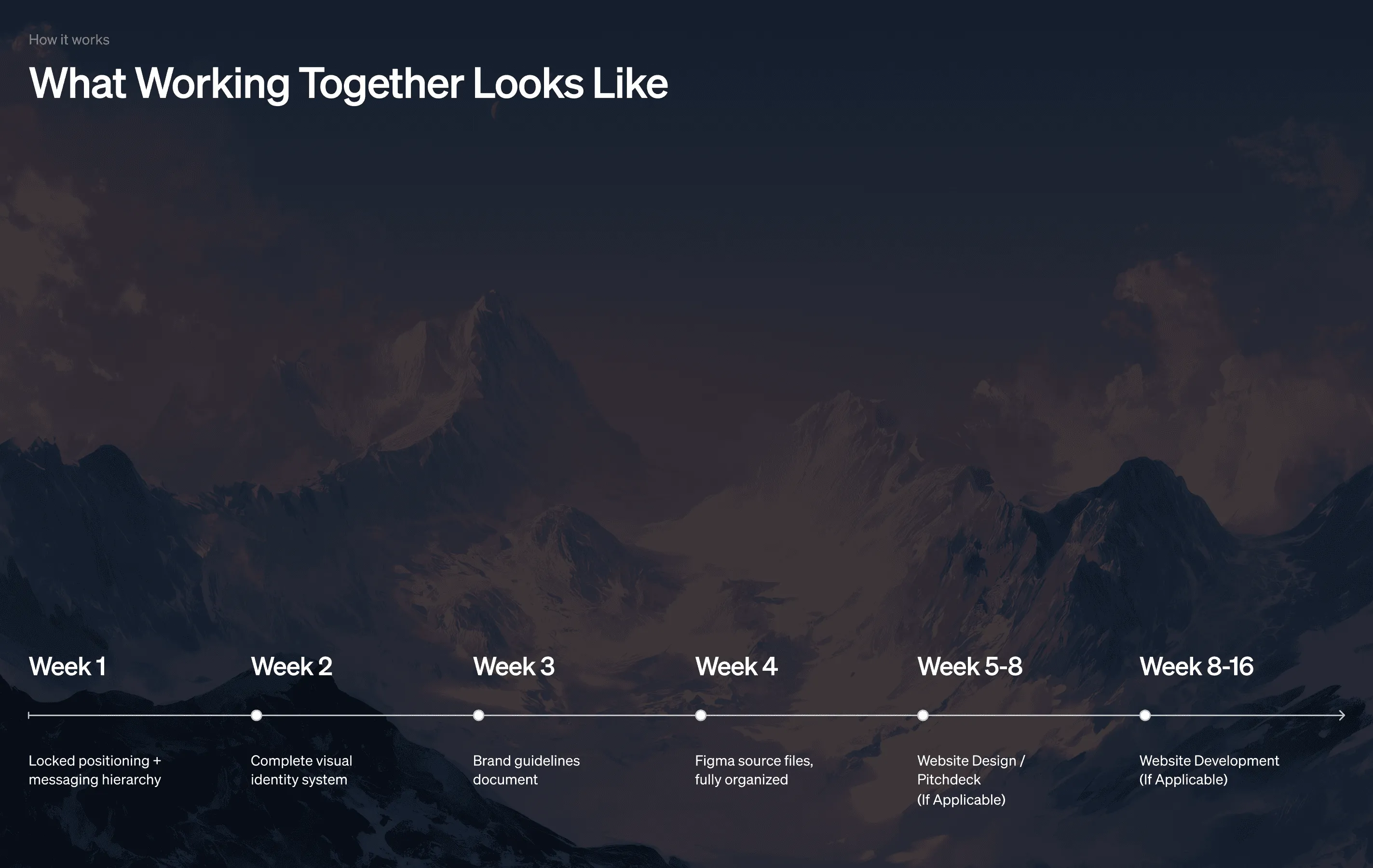
Typical duration: 1–2 weeks.
Stage 2
Resolve
Positioning workshop
An audit with your leadership to pressure-test the category claim, audience definition, and POV.
Messaging ladder
Hero line (7 words), subhead (15 words), elevator (25 words), paragraph, and a FAQ of the 5 questions every prospect asks.
Narrative framework
The story you tell on sales calls, in decks, at events. Written down, defensible, not improvised.
Differentiation rubric
what you do that competitors can’t easily copy, stated in plain language.
This is the stage most agencies skip. They’ll run a discovery workshop and go straight to moodboards because clients find Resolve harder to evaluate (“it’s just words”) and easier to defer (“we’ll figure it out as we design”). Every rebrand that fails to stick fails here.
Customer Conversations. Bryan had no brand, no site, no positioning before Resolve locked one sentence: “Not surveys — real phone conversations with 10–20× higher completion.” The entire brand was built from that lock.
What you walk away with:
A one-page positioning doc signed off by leadership. A scannable messaging ladder ready for copy. A narrative framework usable on sales calls the day it ships. A differentiation rubric you can defend without a slide deck.
Typical duration: 2–3 weeks.
Stage 3
Identity
Visual identity
Logo, wordmark, color palette, typography system, iconography, motion principles.
Verbal identity
Voice rules, tone spectrum, 20–30 sample sentences showing what on-brand and off-brand sound like.
Asset kit
Every visual asset your team will need across surfaces, organized and handoff-ready.
Traceability map
Every identity decision linked back to a Resolve-stage strategy call.
Identity-first design is how most agencies work and how most rebrands die. A logo without a positioning lock is a personal aesthetic preference masquerading as a brand decision. Identity-after-Resolve is how identity survives contact with your investors, your team, your customers.
SUPAHUMANS. Every AI talent platform in 2026 used the same stock portrait — woman in three-quarter profile, blue dot at the temple, grid behind her. SUPAHUMANS’s Identity stage rejected the visual category entirely: human first, capable second.
What you walk away with:
A complete identity system, voice rules with examples, a full asset kit organized for your team, and a traceability map showing every decision one step away from the strategy that drove it.
Typical duration: 3-4 weeks.
Stage 4
Guidelines
Brand guidelines doc
The system documented in a format your team can actually use. Not a 120-page PDF nobody opens. A working reference.
Governance rules
Who owns what, what’s editable, what requires a check-in, what’s locked.
Component library
Figma (or equivalent) library of every reusable element, ready for your internal team or future contractors to pull from.
Implementation notes
Specific guidance for the surfaces your team builds most often: landing pages, decks, social templates, email.
A brand that lives only in one designer’s head dies the day that designer leaves. Guidelines are the difference between a system and a one-off execution. We document as we go — not as an afterthought — because writing the rules down forces us to prove each one is defensible.
Timelaps. Shipped with a full handoff kit — Figma libraries, brand guidelines, implementation notes. The client team could ship new surfaces on the system the week after launch, without asking us.
What you walk away with:
A working brand guidelines document, a component library, governance rules, and implementation notes specific to the surfaces you build most often.
Typical duration: 1–2 weeks (runs in parallel with Home).
Stage 5
Home
Website design
Homepage, core subpages, detail templates for case studies and work.
Website build
In Framer, responsive, performant, SEO-structured, owned by your team from day one.
Pitch deck
Investor, sales, or partnership variant depending on the moment you’re in.
Launch
Launch campaign landing pages if applicable.
Most agencies hand off a guidelines PDF and disappear. A brand that exists only in a guideline document doesn’t exist — it’s a receipt for a purchase. Home makes the brand real on the two surfaces where every deal actually moves: your website and your deck. Everything else — social, email, events — is downstream. Website and deck are the mandatory beachheads.
Averi AI. The Home website shipped as Averi’s first credibility signal — before the product had a customer reference to cite. In the most crowded software category of 2025, the marketing site alone earned an Awwwards Honorable Mention.
What you walk away with:
A launched website, live and measurable, built in Framer so your team can update it. A finalized deck template filled with your real narrative, not placeholders. Deployment ownership from day one.
Typical duration: 4–6 weeks for both in parallel.
Stage 6
Transfer
Training session
A video, recorded, showing them how to extend the system without breaking it.
Asset handoff
All files, in the formats your team will actually use, with a readme explaining how.
Open channel for 30 days
Direct access for the small fixes your team hits in the first month.
A brand that dies in a PDF isn’t a brand — it’s a receipt for consulting hours. Transfer is the difference between delivering files and delivering a working system. The 90-day review is the difference between a studio that cares about outcomes and one that cares about invoices. Most of what erodes a brand in the first year is small: a screenshot sized wrong, a headline written off-voice, a color pulled from last year’s PDF. The review catches it before it compounds
Marcura. What started as a one-month website project became an ongoing partnership across rebrand, sales enablement, events, and social. Transfer didn’t end the engagement — it multiplied it.
What you walk away with:
A trained team that can extend the system independently, a 30-day open channel for fixes, and a 90-day audit report naming what’s held up and what needs tuning.
Typical duration: 1 week initial transfer
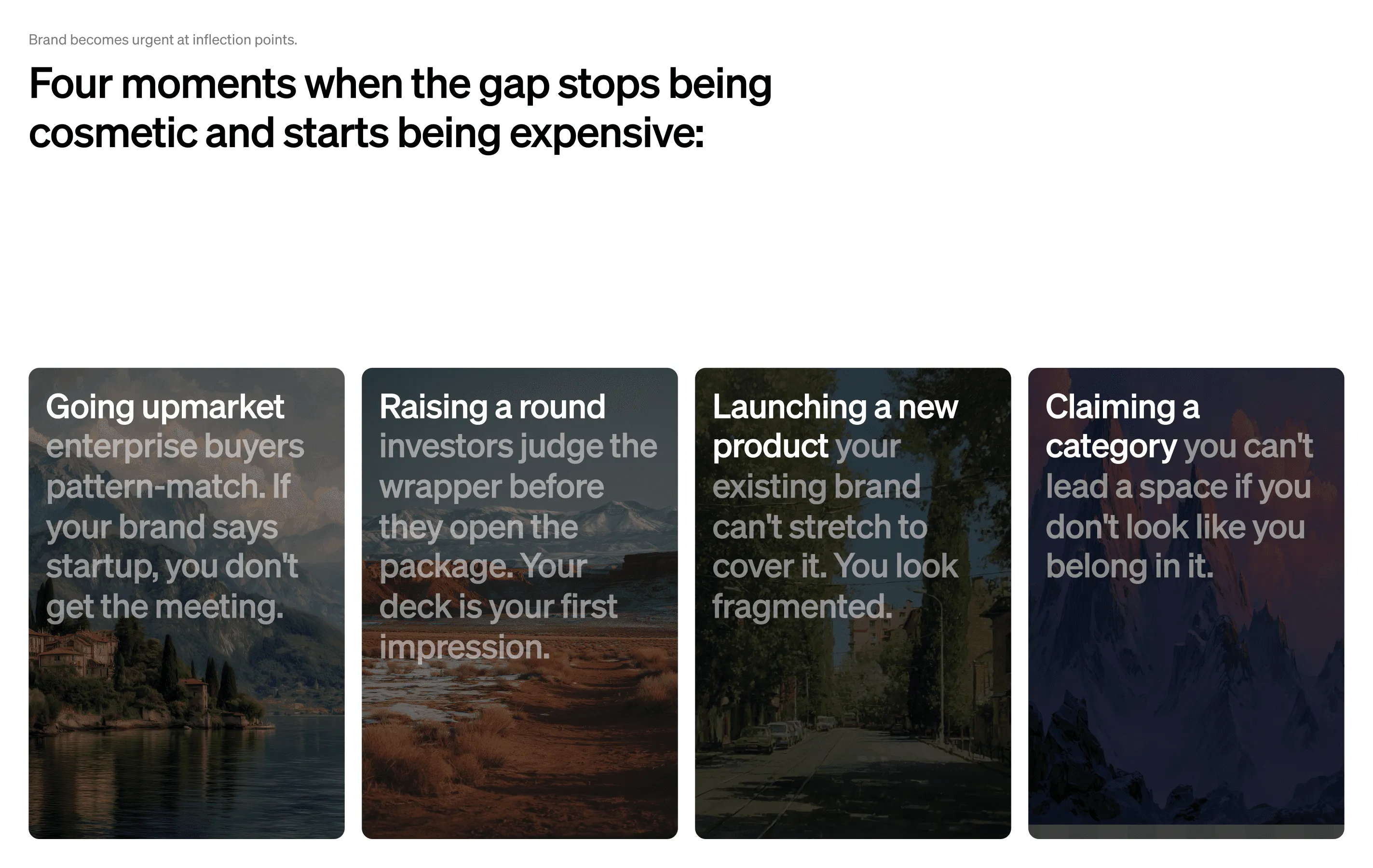
The moment
Four moments when brand becomes urgent.
Going upmarket
New buyers, higher expectations, a brand that screams “startup.”
Post-PMF, pre-category leadership
You need to look like the leader before you are one.
Fundraising narrative gap
Investors pattern-match on surfaces. Early-stage look, early-stage terms.
New wedge, old brand
The identity that fit one product breaks under two.
What the Method rules out on purpose
— Not a logo-only project. Logos don't close deals; systems do.
— Not five visual directions for you to pick from. One recommendation, defended.
— Not a branding exercise without a positioning lock. Strategy first, always.
— Not a ship-and-leave engagement.
— Not a fit if your leadership can't make a call. Single decision-maker required
How we show up
Strategy before aesthetics.
Systems, not assets.
Design that closes.
Radical clarity.
Partnership, not service.
What happens next
The first 15 minutes are free either way.
The Credibility Gap Audit takes 15 minutes and produces a scored diagnostic of your brand's current-state gap — what's working, what's underperforming, and what it's costing you. You keep the result whether or not we work together. If the audit surfaces something worth solving, a 30-minute call with me decides the rest. No deck. No sales pitch. Just whether this is the right engagement at the right moment.