Customer Conversations
Client
Customer Conversations
Sector
AI customer intelligence
Stage
Pre-launch
Scope
Brand identity + homepage
Timeline
Mar 2026
Year
2026
Brand identity system and homepage design for an AI-powered customer intelligence product. We went from zero to launch-ready in three weeks.
The stakes
Every sales conversation started from zero: no brand, no site, no positioning. Half of every first call was spent explaining what the product even was.
The read
How do you brand a product nobody has a reference point for? The AI completes 10–20× more customer interviews than surveys — the brand’s job was to make that instantly gradeable.
The move
Go from zero to launch-ready in three weeks: strategy, identity, and a homepage built to explain the product before the founder says a word.
Summary
Bryan Starck had built an AI that completes 10 to 20 times more customer interviews than surveys. What he didn't have was a brand that could explain why that mattered. We built the strategy, identity, and website that made the product instantly gradeable.
Industry — SaaS, AI Customer Research and E-commerce Intelligence
Services — Brand Strategy, Brand Identity, Logo Design, Website Design and Build
Timeline — Q1 2026
Tools — Figma, FLORA, Midjourney
Inflection point — Post-PMF, pre-category leadership
The Client
Bryan Starck built Customer Conversations, an AI that interviews e-commerce customers by phone. Real conversations, not surveys. The system delivers structured intelligence back to the brand, what customers actually think rather than what they checked on a rating scale, with completion rates running 10 to 20 times higher than surveys.
The Problem
How do you brand a product nobody has a reference point for? Bryan had no brand, no site, and no positioning, so every sales conversation started from zero. Half of every first call was Bryan explaining what the product was not: not surveys, not NPS, not Gong, not a research agency. A buyer who needs five negations before they can place a product is a buyer you lose to anything simpler.
The Decision
We positioned Customer Conversations against surveys specifically. Surveys are the closest mental reference point a buyer already has, and the category with the weakest results, which makes them the perfect thing to be measured against. Leading with "10 to 20 times higher completion than surveys" turned the product into something instantly gradeable. Not a new category a prospect has to learn, but the thing surveys were always supposed to be.
We rejected a broad "customer intelligence platform" positioning that tried to stay category-agnostic. It was too abstract for a cold pitch. We went narrow on purpose, because surveys are a concrete enemy prospects already distrust, and a clear enemy makes a clear brand.
The System
A product with no reference point needs every surface saying the same thing, so the strategy, the identity, and the site were built as one argument. Each piece had a job: the strategy set the comparison, the identity made it feel like a research partner rather than another software vendor, and the site made the metric impossible to miss.
Brand strategy: positioning against surveys, with a messaging ladder
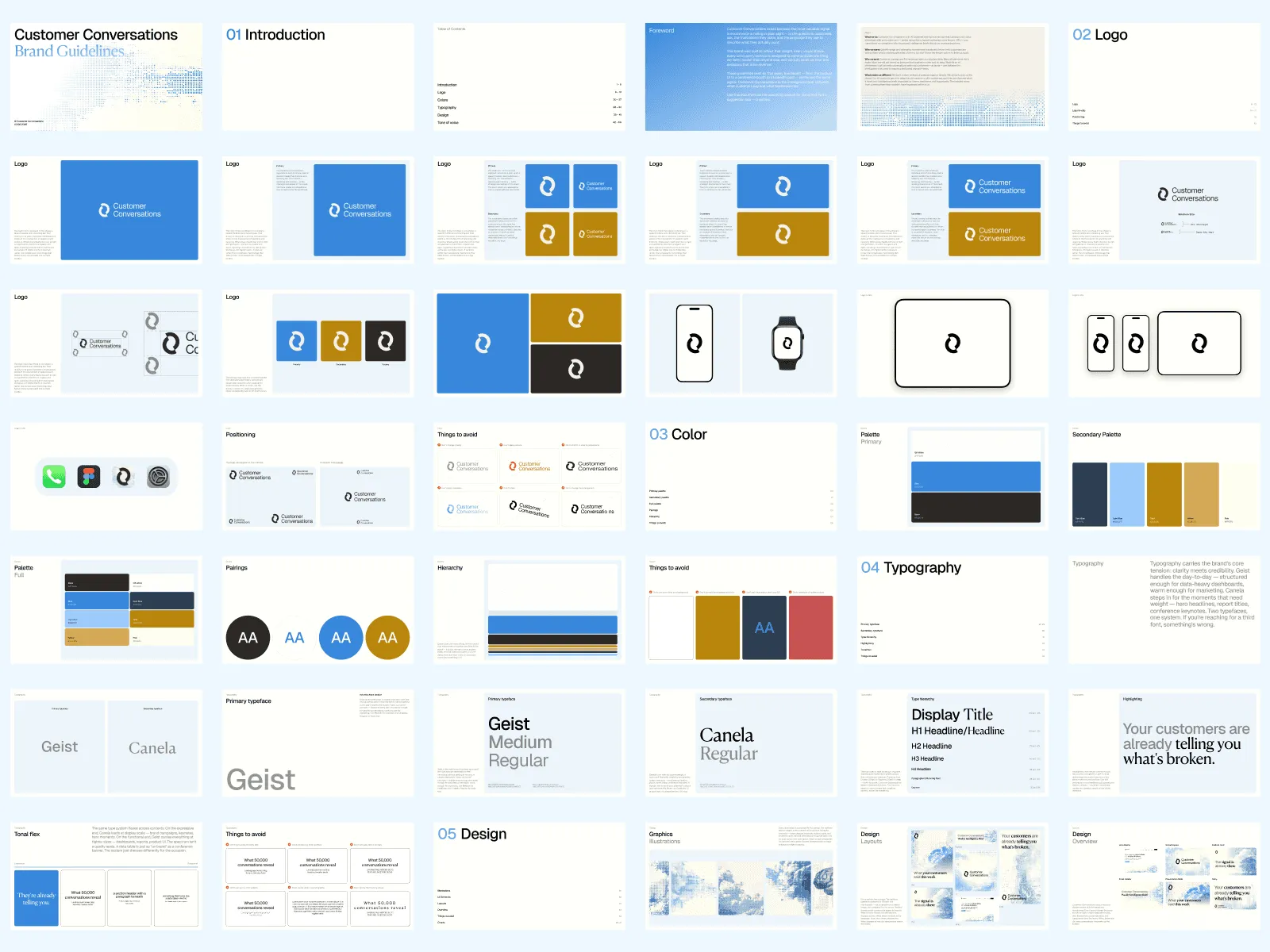
Logo and full brand identity: wordmark, typography, color, iconography
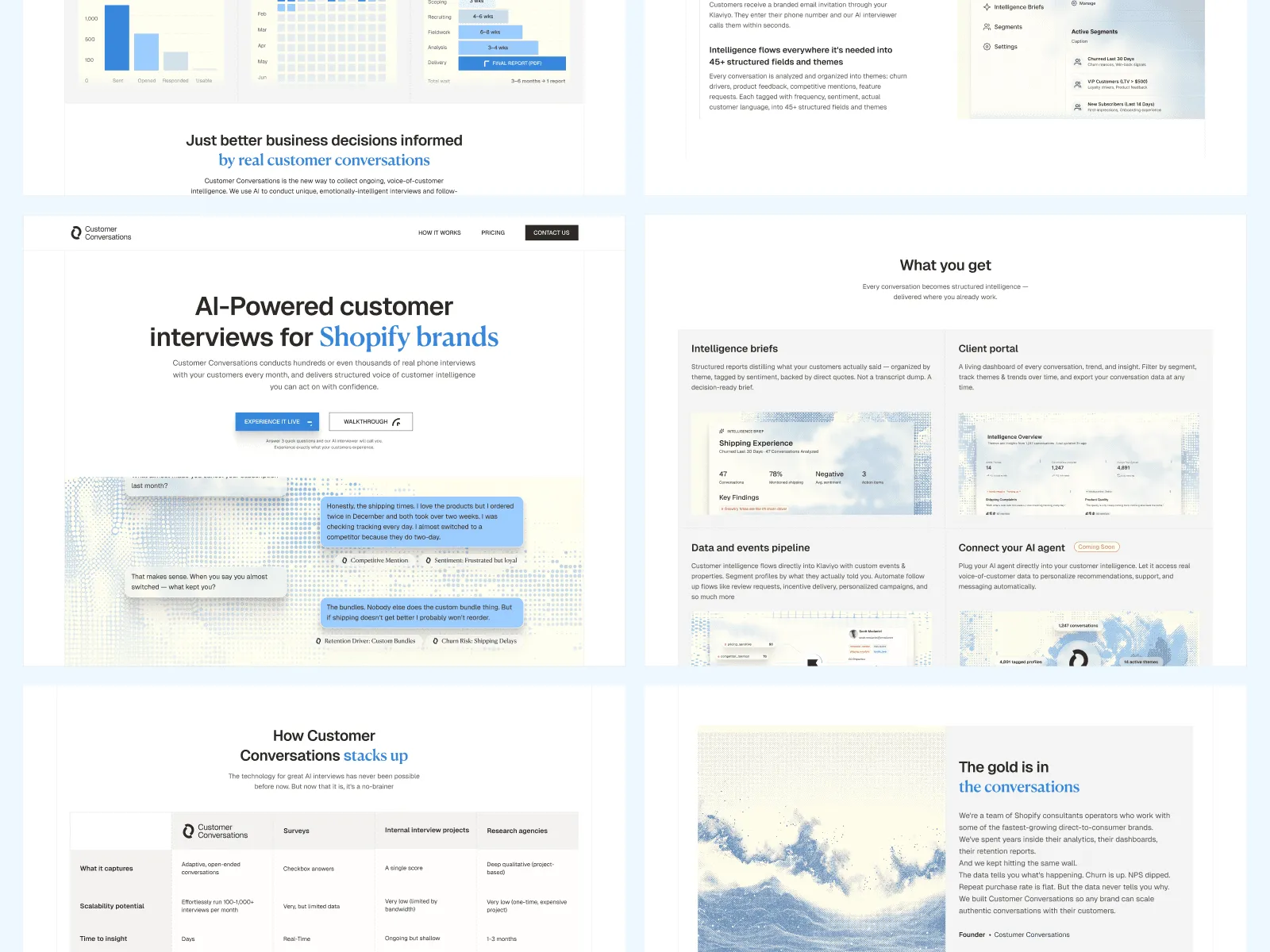
Website, homepage and supporting pages: metric-led, explainer-structured
Verbal identity and voice: written to sound like a research partner, not software marketing
The Impact
The product's strongest fact, a completion rate 10 to 20 times higher than surveys, had been buried inside sales calls. The brand brought it to the surface and made it the hero claim, so the number now does the explaining that Bryan used to do by hand on every first call.
What they said
Logo, full brand identity, and home page design for my new startup. The whole experience was fast and seamless from start to finish.
— Bryan Starck, Founder, Customer Conversations
The Takeaway
A product with no reference point is not a positioning problem, it is a comparison problem. Pick the enemy the buyer already distrusts, and the product explains itself.
Credits — Strategy, Design, Build: Daniel G. Bright, BrightStudios® · Client: Bryan Starck
The system
Brand strategy, identity, logo, and website — a complete launch surface for an AI customer intelligence product, shipped in three weeks.
The audit will show you your gap. Book it.
Fixed $2,000 · 5 days · credited toward any project